HomeAnti-aging, Genetics, health and wellness, Medical News
Thoughts While Running a Marathon in Antarctica
 Dr Sharad
April 12, 2026
Dr Sharad
April 12, 2026
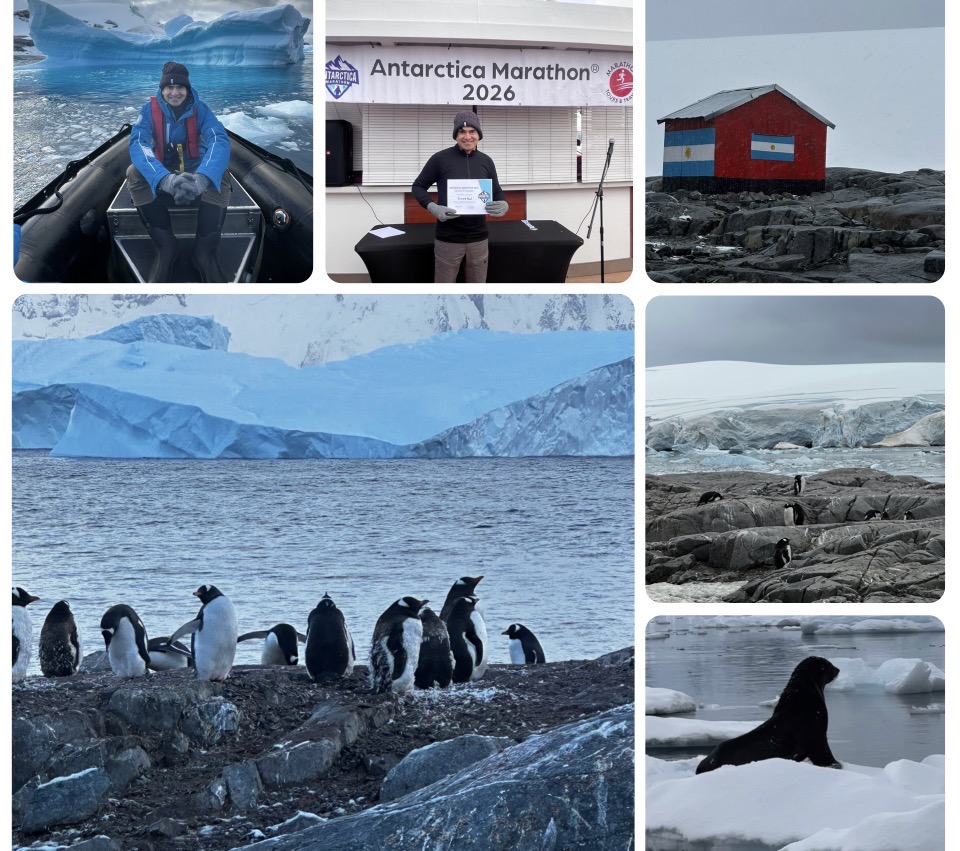
In an island on Antarctica, a single icy, gravelly path bends to follow the Antarctic research stations of Chile, Russia and China. Runners—if you include my ambling while wearing multiple layers of woollens to go with waterproof pants, socks, balaclavas and multi-layered gloves—have to traverse the hilly terrain that bends towards the penguins lining the icy water’s edge. Almost everybody here is a runner, the hundred-odd crazy people that set a goal that perhaps only resonates due to the remoteness, and the exclusivity of such a club becomes an economic impetus for a company to arrange. Of course, the seventh continent has been capturing lives and souls of adventurous spirits for centuries, so this expedition becomes a once-in-a lifetime experience.
Antarctica, essentially a large continental ice sheet, is considered the highest, driest, coldest and windiest place on our planet. The crew on the polar class ship tell me that they think running a marathon on Antarctica is madness. Maybe it seems more than irrational while navigating the violent Drake passage with 20-50 foot waves, with a vomit-bag strategically positioned at every foot of hand railing! Most people seem to be walking around with anti-nausea patches. Fortunately, I don’t get sea sick, even when my balcony door flings open and my room floods. The Drake passage, named after Sir Francis Drake who was blown off course in 1578, can deliver an experience between a calm “Drake lake” and a dangerous “Drake Shake”. I can report that we had a good dose of the latter on our return.
For someone who doesn’t consider himself a professional runner, I do feel like an intruder on this trip. I am a hobby runner who runs under 2 hours a week, between 5-15 kilometres, usually on a single weekend day. Many here have run more than a hundred marathons. Someone who lives near Boston tells me this is her 249th event! Running a marathon on seven continents seems to be a commonly stated goal. When people talk about running clubs, stride coaches and speed drills, I try and take in all this information. And tips like making sure to blow out water from the nozzle of your water bladder and wearing your hydration-pack buried under warm clothing so it doesn’t freeze in these conditions. Guys from Minnesota, Canada and Nordic countries tell me that minus 30 C doesn’t feel that cold to them. During my typical week, my medical practice has long days, so I don’t have the time or a penchant to belong to a group of people doing the same thing. I just run on the weekends with the refreshing solitude offering me time to think, a period of aerobicized meditation. Why am I even here at the bottom of the world? The race was being run on my 60th birthday. When and where else but in Antarctica does one compete in their first-ever half marathon? A patient, Tracey, an inspiration in her 50s, who has run over 50 marathons herself, had put me up to this. As a weekend runner in Auckland, New Zealand, where I usually run in a T-shirt and shorts, I just want to make sure I don’t screw it up!
On my run, with three layers of thermals I am getting hot and sweaty. Lucky, I taped by toes as freezing sweat is notorious for causing frostbite. I am probably running at only around 60-70% of my usual pace, and when I reach the 700-foot hill for the third time, I slack off and look at the penguins silently watching me. I was told that on the previous race, three people had been evacuated due to hypothermia, and one had sustained a bad fall. My aim is merely to complete the damn race. As I run pass the Chinese research station, my watch tells me I am now beginning a workout. China does not trust GPS which is a US governmental system and have their own version called BeiDou Navigation Satellite System (BDS). BDS asks me if I would like to email anyone for help or assistance. I have no idea how much longer I have to run to complete the race, or if it knows something I don’t know. Thankfully, before I know it, I am at the arch signifying the finish and someone is draping a medal around my neck. Whew!
In the USA, they celebrate “sweet 16” and in Anglosphere countries such as UK, Australia and New Zealand, age 21 is celebrated as the key to door of independence. In Asian countries 60 is the big one. In ancient India, Hindu men left home at 60 and wandered off into the wilderness, the period of sannyasa representing the transition from active, worldly duties to a life of spirituality. In China, the thinking goes like this: the first 20 years are really for your parents; the second 20 to settle into your career, and the third 20-year period is a time to sort out your children or family matters. 60 is therefore viewed as the age where a new life—one that is all about you—begins. Most people in Asia only celebrate this landmark. I must say I am not really a celebrator of birthdays. 60 seems like an unwanted proscenium into the next stage of life. A biologic clock with no hands that perhaps beckons you to exercise your freedoms to greater reaches while you can. As a doctor and someone who actively promotes the concept of health span in my books such as Biohacking Your Genes, this is also the time when balance, aerobic capacity, and hip flexibility, the foundations for functional fitness need more attention.
Ancient humans ran only when they felt threatened. Otherwise, as man walked upright and developed the ability to walk long distances they developed larger brains. Which is why leg movement exercises are the best for brain function. I wrote extensively about the benefits of the Tango in my previous book, The Genetics of Health. What about running? Running as a divertissement is a human fiction. It is a great made-up form of exercise that has been built up to what it is. Physical performance that is practised to project your personality onto the big screen inside your mind.
In general, runners are said to live approximately 3 years longer than non-runners. About a decade ago, the Copenhagen City Heart Study suggested that running had a U-shaped curve when it came to health benefits i.e., even 10 minutes a day at slow speeds (<10 kilometres per hour) was associated with marked reductions in mortality risk but more than 4 hours per week did not provide additional longevity benefits and could end up doing the opposite! However, this was disputed by others who pointed to a Swedish study of long distance skiers. The mortality amongst participants in Vasaloppet, which is a long-distance ski race in Sweden showed a 52% reduction of all-cause mortality, with older participants and those that competed in many races faring the best. However, the counterargument is that cross- country skiing and running are different forms of exercise. However, more recently a large meta-analysis article in the British Journal of Sports Medicine studied over 200,000 runners for periods between 5 to 35 years. What was interesting was that running pace and distance didn’t matter. Anyone who ran for less than 50 minutes a week saw these benefits (including lower cancer and cardiovascular system disease rates), but running for longer amounts of time didn’t lower mortality risks further. So maybe if you want to run for functional fitness, then start with just 30-second intervals of running at your briskest pace with two to five minutes of walking in between. More than four hours a week does not seem to add much value.
In the end, the conditions for a run were abominable in Antarctica and my mud-soaked shoes took interminably long to clean, but a motley assemblage of spectators, penguins and seals provided a wonderful farewell. I met some really genuine people. Siobhan, a neuro-physiotherapist from Belfast; Joel, a Canadian photographer-content creator living in the UK; and many others on brief chatty confabs. But everyone in the end was saying things like: “I cannot believe we did this”, “It’s a most amazing lifetime experience” and “You can’t put this in words—it’s Antarctica.” Antarctica was in the end a series of artistic set pieces, chunky impossibly blue icebergs, napping whales, galumphing seals and pongy penguins. Its real beauty was in the constant change of colours and flourishes that expanded our visual horizons.
Footnote: For patients that wondered where I had disappeared to this time, this was where I was, even though I was still responding, when possible, to your skin cancer queries and online consultations. For the record, I ended up finishing second in the Seniors category and even have a medal to show for it.
THE END

Written By
Dr Sharad Paul


Dr Sharad Paul is an award winning, world renowned recognised skin-cancer expert and thought-leader.