HomeAnti-aging, fitness, health and wellness, Medical Mysteries, Medical News, running
Running and Longevity: The Wisdom of the Second Half
 Dr Sharad
August 21, 2026
Dr Sharad
August 21, 2026
I say this to reassure many patients who ask me about bringing their children for skin cancer checks. In general, we lose our beauty, or develop cancers, after our reproductive peak. Evolution is all about survival of the species. This is why cancer is extremely rare in the very young. Life is an endurance sport.
There is a peculiar thing about running a long race. The first half is largely physical. The second part is philosophical.
Somewhere after the early enthusiasm has disappeared, the legs begin to complain, and the finish is still inconveniently far away. This is when running stops being about speed. It becomes a negotiation between the person you imagined yourself to be at the start and the person your body is prepared to be now.
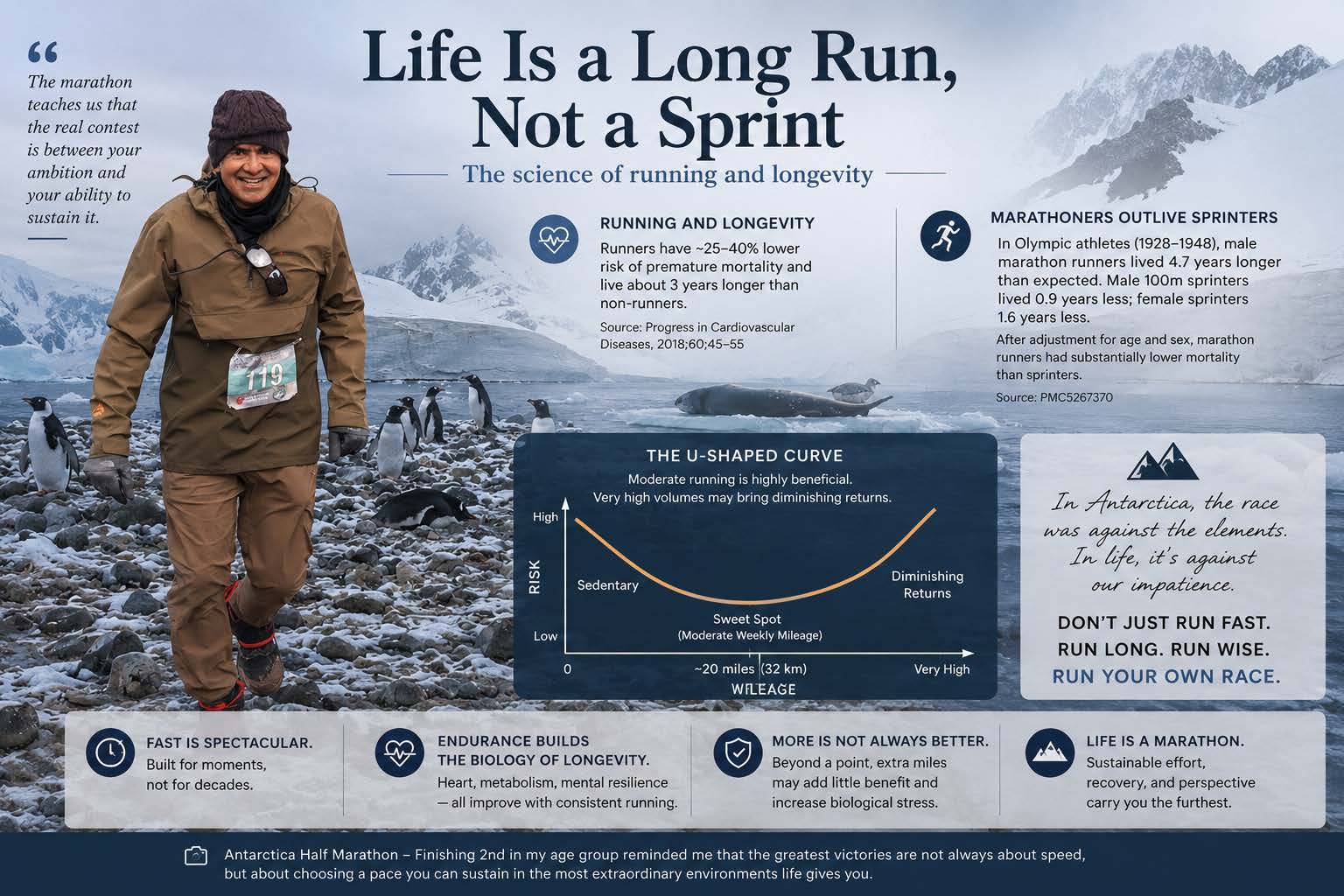
I know this as a hobby runner. I have even managed to finish second in my age group in an Antarctica Half Marathon. This sentence only sounds better to my ego if I don’t enquire too closely into how many people in the world are foolish enough to be running through Antarctica anyway. I hadn’t even told my very elderly parents, knowing they would worry. My scientific mind won’t let me get carried away. It was the luck of small numbers, and too small a sample size.
But running has taught me something medicine also tells me repeatedly:The body is less interested in brilliance than sustainability.
The Paradox Of The Sprinter
A study of Olympic athletes from the Games of 1928 to 1948 produced a curious result. Researchers compared 100-metre sprinters with marathon runners, high jumpers and discus throwers. Male marathon runners lived, on average, 4.7 years longer than expected for their age, era and country. The sprinters showed no comparable longevity advantage.
This does not mean sprinting kills you. These were elite athletes from another era, the numbers were modest, and association is not causation. But the finding is philosophically irresistible. The human being capable of moving fastest was not necessarily the one who travelled furthest through life. Perhaps because speed and endurance are different biological ambitions. A sprinter asks the body for everything now. A distance runner asks the body to leave something for later.
The Economy Of Endurance
Endurance is really an exercise in biological economics. You have a finite supply of glycogen. A measurable ability to dissipate heat. A heart that must keep supplying oxygen. Muscles accumulating fatigue. Tendons absorbing thousands of impacts.
The inexperienced runner thinks the challenge is to go faster. The experienced runner knows the test is to spend wisely.
That may help explain why even surprisingly modest amounts of running are associated with longevity. Large observational studies have found lower all-cause and cardiovascular mortality among runners, and a major review estimated that runners live about three years longer than non-runners.
But there is an intriguing equation here. The relationship between exercise and longevity may not be a straight line. Some research has suggested a U-shaped curve: moving from the sofa to regular running produces a large benefit, while progressively greater amounts of strenuous exercise do not necessarily produce progressively greater longevity.
There have been attempts to place numbers on the upper end. 20 miles a week is sometimes quoted, but biology rarely respects round numbers. Other studies have found continued benefits at higher running volumes, and the evidence does not justify telling someone that mile 21 suddenly cancels mile 20. The more interesting lesson is that health and performance are not the same objective.
Training that makes you faster may continue to improve performance long after it has stopped adding much to longevity. That distinction matters.
When More Stops Meaning Better
Medicine has spent much of its time discovering dose and effect.
A little water saves you from dehydration. Enough water sustains life. Several litres consumed rapidly can kill you. Sunlight makes vitamin D and helps set our biological clocks. Too much ultraviolet radiation causes cancer. Food is necessary for survival. Excess food is now responsible for an extraordinary burden of disease. Even oxygen, the molecule without which we die within minutes, can damage cells in its superoxide form. The great mistake is assuming that because something is good, more of it must be better.
We make the same errors outside medicine. More money. More success. More productivity. More followers. More possessions. More years. We have become very good at measuring accumulation and remarkably poor at asking when we have enough.
Running offers a corrective. A runner who refuses to listen to fatigue eventually discovers that physiology has the final vote.
The Long Race
When I was younger, I suspect I thought success meant getting somewhere. Now I increasingly think it means being able to continue. That is why I am all about health span. This is the message in my books, The Genetics of Health and Biohacking Your Genes. And one I am working on right now!
There is a difference. A career can be spectacular and unsustainable. A company may grow rapidly and collapse. A person could optimize every measurable aspect of health and forget to enjoy being alive.
Even longevity itself can become another race we are desperate to win. Yet there is something faintly absurd about rushing towards a longer life. The best runners learn pace. They know when to push and when to ease back. They understand that recovery is part of training rather than an interruption to it. Most importantly, they understand that the energy you spend now is energy you cannot spend later. Perhaps ageing well requires the same intelligence. Not inactivity. Not timidity. Not avoiding difficulty.
Pacing. I still like running quickly. I am a competitor, and I am not surrendering my Antarctica result just yet. People on that trip are tempting me to do the Arctic. But the older I get, the less interested I am in my fastest kilometre. I am more interested in whether I will still want, and still be able, to lace up my shoes twenty years from now.
Because perhaps the most important part of any long race is not the start, or even the finish. It is learning how to run the part in between.
THE END
References
- Lee-Heidenreich J, Lee-Heidenreich D, Myers J. Differences in life expectancy between Olympic high jumpers, discus throwers, marathon and 100 meter runners. BMC Sports Sci Med Rehabil. 2017;9:3.
- Lee DC, Brellenthin AG, Thompson PD, Sui X, Lee IM, Lavie CJ. Running as a Key Lifestyle Medicine for Longevity. Prog Cardiovasc Dis. 2017;60(1):45–55.
- Schnohr P, O’Keefe JH, Marott JL, Lange P, Jensen GB. Dose of Jogging and Long-Term Mortality: The Copenhagen City Heart Study. J Am Coll Cardiol. 2015;65(5):411–419.
- Lee DC, Pate RR, Lavie CJ, et al. Leisure-Time Running Reduces All-Cause and Cardiovascular Mortality Risk. J Am Coll Cardiol. 2014;64(5):472–481.
Footnote: This a personal blog and should NOT be considered individual medical advice.

Written By
Dr Sharad Paul


Dr Sharad Paul is an award winning, world renowned recognised skin-cancer expert and thought-leader.