HomeGenetics, Medical Mysteries, Medical News, mental health
Happy Endings from the Holy Roman Empire
 Dr Sharad
October 25, 2026
I was in Hamburg and Vienna recently, delivering the main keynote address at the German Dermatological Surgical Society’s annual meeting, followed by an AI (artificial intelligence) in dermatology conference. The European Academy of Dermatology and Venereology had twenty two thousand doctors attending! It was humbling to see my scientific contributions to skin tension lines acknowledged in Hamburg, and I was even made to sign copies of the Annals of the Royal College of Surgeons of England that had featured my work on its cover.

I love these sojourns into Europe as its landscape is so spectacular with a storied history that extends to architecture and scientific research. Downunder, we live in new worlds with vast open spaces with less people and cleaner air, but rather poor in human civilizational history. I stayed in an apartment that was a very close walk from Stephansdom (St Stephen’s Cathedral) which was first consecrated in 1147 AD!
Both Hamburg and Vienna have a historical connection that is not widely known. Around forty years after St Stephen’s was built, Frederick I (also known as “Barbarossa” due to his red beard) made Hamburg a “free imperial city” within the Holy Roman Empire. The imperial city of Vienna later served as the de facto capital of the Holy Roman Empire through the Habsburg dynasty for several centuries.
Returning to deliver a lecture in Vienna for the third time, I was once again amazed by the beauty of its imperial buildings. While perhaps no other place in the world has a visage where every building in the city centre is virtually a museum, Vienna also has the soul of an insecure city where its foray into its recent Nazi history remains a cross to bear.
For both the tourist and the local, the identification between Vienna and the erstwhile Habsburg Empire is profound and inseparable. The Habsburgs had a motto: Bella gerant alii, tu, felix Austria, nube. The translation from Latin, which was the official language until Joseph II replaced it with German in the late 18th century, reads: “Let others wage war; you, fortunate Austria, marry.” Today, I was told because movement within the Schengen area is easy as long as you can speak German, Vienna has many people from Serbia, Germany, Turkey and Ukraine living and marrying in the city.
However, historically the Habsburgs arranged strategic marriages to consolidate their kingdom’s strength even if it meant marriages to close relatives. After all there were only so many royal families in Europe. Even Napoleon used the Habsburgs as a way to claim a royal lineage that he desperately desired when he married Marie Louise, the 18-year-old daughter of Emperor Francis II, the Holy Roman Emperor. However, Napoleon did not even bother attending his own wedding! The bride’s brother, Archduke Karl acted as Napoleon’s bridegroom-double at the wedding in Vienna on March 11, 1810.
As I wandered through the magnificence of the Habsburg Palace (winter residence) and completed a 10k weekend run through the gardens around the Schönbrunn Palace (summer residence of the erstwhile royalty) two questions came to mind:
- Why would someone have summer and winter residences in the same city?
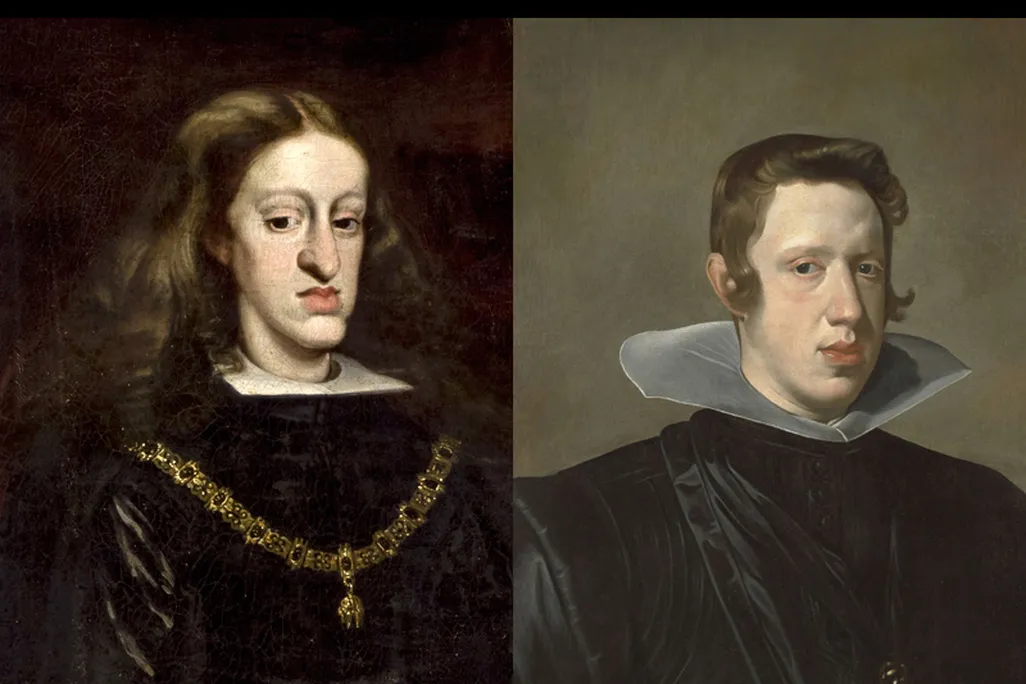
- What was the story behind the almost unusual facial features of the Habsburgs?
It seemed dumb to have summer and winter palaces in the same city, especially when the greater kingdom included places like Spain and Portugal. And, to someone who teaches and deals with facial anatomy while reconstructing tissues after removing skin cancers on a daily basis, something was amiss in the portraits of Habsburg royalty, with faces too difficult to unsee. These paintings appeared to belittle the historical greatness and seemed anachronistic to the architectural splendour that housed them. “I don’t think royalty sits well on this couple,” I hear someone say looking at one picture.
It turns out there is a scientific explanation. Among the things that have stayed with me since I have been writing about genetics in my books, Skin, a Biography (4th Estate) and The Genetics of Health (Simon and Schuster) is that genes are our blueprint, but not our destiny. But in the case of the Habsburgs, their wish to influence their fate meant that around nine percent of a Habsburg royal’s corresponding genes (one maternal, one paternal) were identical because they came from the same ancestor, giving them an “inbreeding coefficient” of 0.093 (lower the better). For example, the child of two first cousins would have an inbreeding coefficient of 0.0625; England’s King Charles, therefore has an inbreeding coefficient of 0.004. This became worse for the Habsburgs down the line and eventually terminated the Spanish arm of the dynasty when 38-year-old Charles II, a king with severe health issues and infertility attributed to this severe inbreeding, died in 1700. Charles II was named the El Hechizado, or “the bewitched” for his very large tongue, epilepsy and other illnesses. He had an inbreeding coefficient of 0.25 i.e., about the same as the offspring of two siblings. The famous “Habsburg Jaw” has been widely studied in scientific journals. Alexander Stanhope, who was British Minister at Madrid during his reign described Charles II as follows[1]: “…has a ravenous stomach, and swallows all he eats whole, for his nether jaw stands so much out, that his two rows of teeth cannot meet.”
As rulers of the Holy Roman Empire, the Habsburgs followed the theology of the times that suggested that the heart was the spiritual seat of the soul. Therefore after death, Habsburg bodies were dissected and stored separately in Vienna. The heart was stored in a silver urn inside the “heart crypt” (Herzgruft) that is located in the Augustinian Church; the entrails were put copper urns in the crypt that is beneath St. Stephen’s Cathedral; the bodies lie entombed in the Imperial Crypt (Kapuzinergruft) beneath the Capuchin Church even today. So while the other dynasties of Europe hoped to rest in peace, the Habsburgs rested in pieces.
The Habsburgs had another quirk. Emperor Joseph II felt that the role of a ruler was also to control national consciousness. It was part of his philosophy: “Everything for the people, nothing by the people”, and issued a royal decree that plays performed at Vienna’s national theatre had to feature joyful conclusions to keep the public mood elevated.
These happy endings were called “Viennese endings” (Wiener Schluss). A journalist I met, Nina, mentioned this fact to me, and I didn’t believe her at first. Aren’t the oddities I have mentioned in this blog not enough? However, she insisted I accompany her to a local stage production of Hamlet, which was being performed by a smaller repertoire theatre with a nod to the past. Sure enough, even if the play was in German, it was clear Hamlet did not die in his duel but lived on. The unusual premise was delivered with quintessentially serious German severity, extracting pathos from the play’s blasphemous (for Shakespeare fans) endings.
You must see Romeo and Juliet, she whispered, “Juliet does not use a dagger, and they become an old couple together.” To a medieval monarch, it was a convenient solution for consolidation of his popularity. Viennese sensibility to me seemed funny but also somewhat wistful.
THE END
[1] Spain Under Charles the Second; Extracts from the Correspondence of Alexander Stanhope 2nd Edition: John Murray, London MDCCCXLIV page 99)

Written By
Dr Sharad Paul


Dr Sharad Paul is an award winning, world renowned recognised skin-cancer expert and thought-leader.