HomeAI, climate change, health and wellness, Medical News, Skin Cancer, Skincare
Artificial Intelligence and Natural Human Stupidity
 Dr Sharad
November 28, 2026
“The truth is: the natural world is changing. And we are totally dependent on that world. It provides our food, water, and air. It is the most precious thing we have, and we need to defend it.”
~ Sir David Attenborough, quoted by WWF Australia
Around fifteen years ago, I was talking to a friend in America who had worked at IBM and then went on to be employed by many of the major tech giants in America. We were talking about the “internet of things” i.e., new technology that enabled you to control your microwave oven or other domestic appliances from your mobile phone.
“What’s the point of that?” The microwave, to use the same example, isn’t complicated to use so why make it connected to the internet? The obvious one was that it enabled technology companies to know our eating patterns, dinner timings and sell that data to marketing agencies. What my friend said was especially revealing: “The discussion that comes up in our innovation meetings is not how to improve people’s lives but how to make their lives unliveable without being connected to our digital networks.” Now a lot of what we discussed has come to pass. I cannot write a prescription without logging on to my computer; even my television at home needs a phone connected to the internet to change channels!
Today I saw an article in the newspaper that mentioned that OpenAi, the artificial intelligence (AI) company that launched the ubiquitous ChatGPT launched Open Works, a pilot program that pays local AI experts up to $8,000 a month to give hands-on AI training to small businesses. Money to show these small businesses that they don’t need people to do many routine admin tasks. Of course once these companies invest in making all their systems run by AI, and divest of individuals, there is no going back for both parties. Stealthy enslavement by AI subscriptions. Thomas Jefferson, the American President, once wrote that maintaining slavery was like “a wolf by the ear, and we can neither hold him, nor safely let him go.”
When people refer to AI as artificial intelligence (or super intelligence, if you are naturally super stupid), the use of “intelligence” makes me somewhat annoyed. A calculator was always able to perform mathematical tasks better than humans, but does that mean it is smarter? In my view, AI, at this point in time anyway, is more about pattern recognition rather than true intelligence. I agree it has been a triumph of human coding and computer programming, stealing creativity from writers, filmmakers, scientists and textbooks, and making machines learn these patterns.
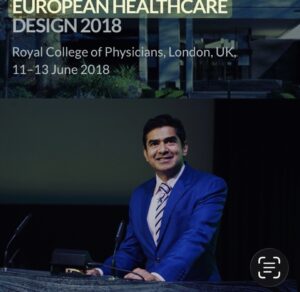
I should know something about pattern recognition in my thirty years as a skin cancer doctor, scouring through hundreds of moles, freckles and assorted uglifications to find the tiny malignancy. Several years ago, I was credited with detecting one of the smallest melanoma skin cancers ever known at that time, a “micromelanoma” under 2 mm. In 2018, I delivered an opening keynote at the European Healthcare Design Conference at the Royal College of Physicians in London. In my lecture I divided medical specialties of into three types: physicians (paediatricians, adult physicians and geriatricians), proceduralists (surgeons, gastroenterologists etc) and pattern-recognizers (radiologists, pathologists and dermatologists). In was in the latter that AI would make a bigger impact early was my explanation.
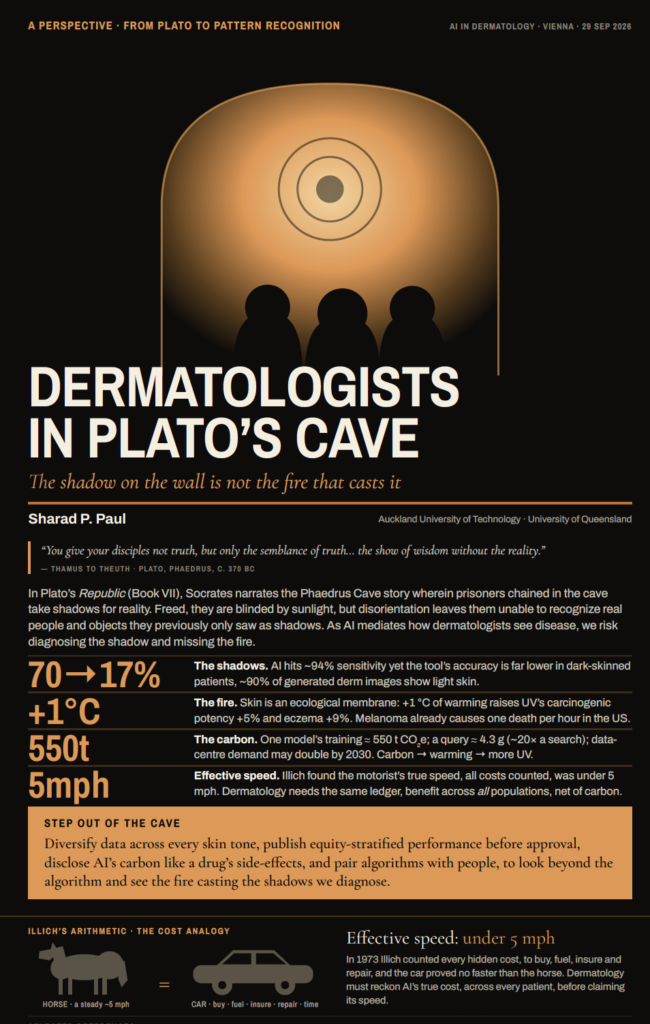
A decade later I found myself, merely a few weeks ago, at the AI in Dermatology Conference in Vienna. My presentation was titled “From Plato to Pattern Recognition”. At an event where everyone was congratulating each other for developing a new model to detect a skin condition, or a device to scan for skin cancers, or looking for wealthy funding partners, my philosophical talk got relegated to a footnote. I guess when everyone is talking about technological advances in AI, it is easy to overlook the main drawbacks of this new AI boom: energy and equity.
According to Lawrence Berkeley National Laboratory, AI will consume more than 50% of all energy going to data centres and 22% of all electricity in the USA within two years! Why does this matter? For every degree Celsius rise in global temperature, skin cancer cases rise by more than 5%, and eczema by almost 10%. The reason is as much biological as it is philosophical. We live on the surface of the earth, so skin as our barrier organ is exposed to anything the planet is exposed to at terra firma. Even airline pilots have twice the risk of melanoma, the sometimes deadly skin cancer.
In my book, Skin, a Biography, I wrote that skin was not only our only universal organ, but the only essential organ for life. There are creatures without hearts and brains, but everyone has skin. Dermatology inadvertently ends up a humanistic discipline of clinical wisdom and pattern recognition. Machine learning relies on data transparency and explainable methodology. When viewed from the context of AI being a pattern recognition tool rather than a substitute for human intelligence, what I am going to say makes sense. Because dermatology datasets are curated from select patient populations, lack standardized metadata, and provide limited information about image acquisition or selection methodology, they create a recipe for bias. AI was over 70% accurate (and improving) in detecting skin diseases in white-skinned European-descent populations but when one looked at darker-skin (generally poorer, from the global south, and therefore less AI training of models in such populations), the accuracy dropped to around 17%. Less than tossing a coin! Image a treatment or diagnostic modality that only works for a portion of the world’s population but also increases the disease burden? That is the paradox of AI in dermatology at present. If this wasn’t a technology investment but a pill, would we approve such a medication?
Ivan Ilich wrote a book coincidentally titled Energy and Equity in the 1970s when he compared the advent of new technology such as the first motor cars after centuries of horseback. When viewed through the lenses of energy and equity, he calculated the actual societal time invested i.e., when you factor in time spent working to pay for a car, fuel, insurance, and parking, a person driving a car does not move at 60 or 100 miles per hour on the motorway but only travels at about four miles per hour i.e., not much faster than horseback! There is a moral hiding somewhere in this.
You may have recently seen the film The Odyssey. You may also know that Homer’s great works The Iliad and The Odyssey were oral works composed in the 7th century BC, because the written alphabet only emerged around 3400-3200 BC in Egypt. The Greeks believed that the God Theuth (or Thoth in Egypt) invented everything, including writing. In Plato’s Republic (Book VII), Socrates narrates the Phaedrus Cave story wherein prisoners chained in the cave mistake shadows for reality. In a scene where God Theuth promotes the written word to the (mythical, not historical) King of Egypt, Thamus, stating that his Majesty’s greatness could now be recorded for posterity, the wise Emperor replies: “You give your disciples not truth, but only the semblance of truth… the show of wisdom without the reality.” That’s what I see happening when we mistake AI for real intelligence, rather than as a show and tell of pattern recognition.
I would be less cynical about a futuristic bland world where there is no more a possibility of a Mozart or indeed a Homer due to AI, if the proponents of the technology showed more human values and respect for the natural world. Have you ever seen tech billionaires such as Elon Musk or Sam Altman post pictures of dogs or nature rather than constantly whinging about being persecuted by the taxman or inferior human races, females and poor mortal peasants? Google recently decimated a forest in Finland to build a datacentre. Over 250,000 trees were removed without permission. News reports mentioned that Google even removed the topsoil with the trees, leaving behind mud indented with the trail marks of machinery, puddles and mounds of bald earth that can be viewed from space. Speaking of space, there was a report out just today that said that Musk had obtained approval from Donald Trump (who else?) to build a million (why would it be any less for a trillionaire?) data centres alongside his satellites. Who needs permission when governments roll over for big technology, especially when it has something to do with AI and money, right?
Pythagoras, the Greek mathematician wrote about three types of men among Olympic spectators: the lowest were the sellers of goods; next the competitors, and at the top of the rankings were the people who watched. Now the roles are reversed in a world of elitist corporate socialism masquerading as capitalism. The terrible reality of AI in this context is that this is calculated theatre, a plagiaristic pursuit where the thinking is that we humans are too soft and dumb to survive. On stage are politicians, venture capitalists, real estate agents, social media influencers and technology titans assessing what they can extract from each other, and us.
As I travelled on the last leg of my international lecture tour, culminating in this talk about AI in dermatology, I wondered if humanistic values had a place in that community, or it was just me, an eternal misfit. There is a natural human stupidity in only looking forward because modernity does come with a tragic slippery slope that is easy to miss.
THE END
PS: AI was not used in writing this article. I do know enough about AI to use it as a research assistant to find patterns in research papers or analyse my results.
Written By
Dr Sharad Paul


Dr Sharad Paul is an award winning, world renowned recognised skin-cancer expert and thought-leader.